




Highlights
- Neurodivergent, neurodifferent, and neurodiverse are all used to describe people whose brains work differently from what society considers “normal.”
- Attention-deficit hyperactivity disorder (ADHD) is a form of neurodivergence, but being a neurodivergent person doesn’t automatically mean you have ADHD.
- ADHD, autism spectrum disorder, Tourette’s, and dyslexia are some well-known examples of neurodiverse disorders.
When you hear that someone is neurodivergent, you possibly assume that they process information in a way that is not considered “standard.” You may also know that people with attention-deficit hyperactivity disorder (ADHD) can think or behave differently, so you wonder if ADHD is considered a neurodivergent condition. This article will define what neurodivergence is and look at whether ADHD is a type of neurodivergence.
Is ADHD Neurodivergent?
Yes, attention-deficit hyperactivity disorder (ADHD) is considered a neurodivergent, not a neurotypical, condition.
ADHD is a neurodevelopmental disorder, present from birth and previously thought of as a childhood condition. Although frequently it’s only diagnosed in adulthood.
The ADHD brain is wired differently, resulting in
- Hyperactivity
- Impulsivity
- Poor attention and focus
Let’s look at what neurodivergent means, so that you can understand why ADHD fits here.
What Does "Neurodivergent" Mean?
Let’s look at the meaning of neurodivergent.
- Neuro = brain; the organ that forms our thoughts and feelings and processes the world around us through the senses
- Typical = normal, usual, or common
- Divergent = taking a different or unusual direction
This implies that neurodivergent brains function differently from what is considered “normal,” or neurotypical.
Neurodivergence is a blanket term covering many diagnosed conditions; ADHD is only one of these. So, a person with ADHD is neurodivergent, but a neurodivergent person may not always have ADHD.
Neurodiverse and Neurodivergence Differences
What about neurodiverse? Are neurodivergence and neurodiversity the same?
Strictly speaking, neurodiversity refers to:
- Neuro = human brain
- Diversity = varied or a mixed bag
This means that neurodiversity covers everyone on Earth.
Every person’s brain and, therefore, the way they think, feel, and experience the world will be as unique as their fingerprint. So, a neurodiverse individual’s neurological differences are seen as natural variations.
The term ‘neurodiverse’ came before ‘neurodivergence.’ In the 1990s, the neurodiversity movement
In reality, ‘neurodivergent,’ ‘neurodifferent,’ and ‘neurodiverse’
Neurodivergent and Neurotypical Differences
Neurodivergent people generally have spiky IQ profiles: high-functioning in some areas and experiencing challenges in others.
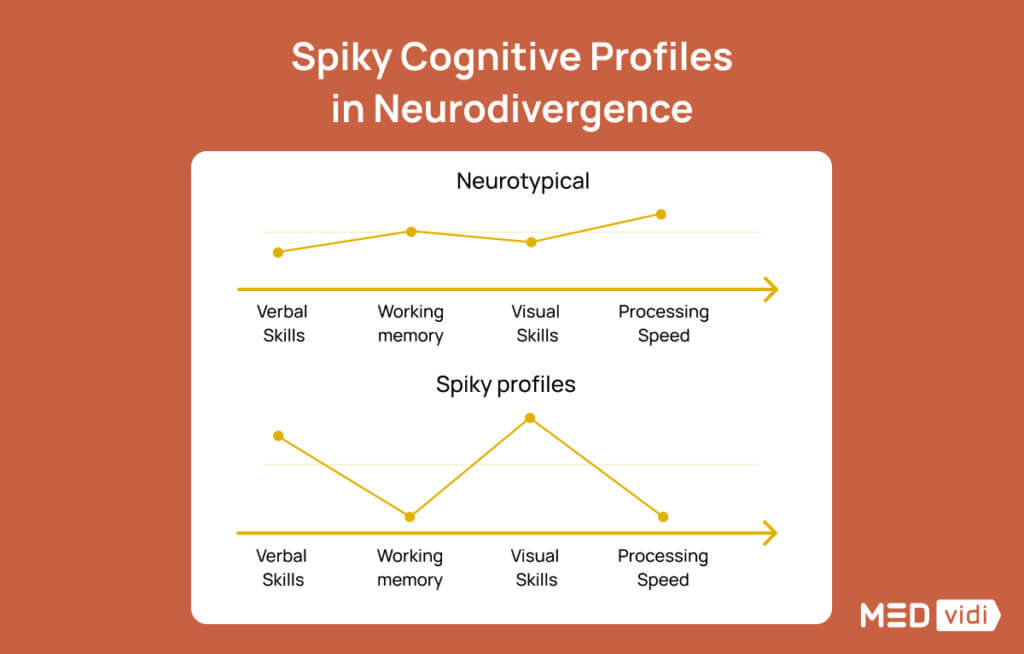
Source: Doyle N. Neurodiversity at work: a biopsychosocial model and the impact on working adults. British Medical Bulletin. 2020;135(1):108-125. doi:https://doi.org/10.1093/bmb/ldaa021
Neurotypical people have a more even profile, allowing them to function in our neurotypically oriented society and institutions.
So, neurodivergent traits are extremes; here are some examples.
| Trait | Dialed up | Dialed down |
|
Sensory disruptions |
|
|
|
Movement |
|
|
|
Focus and attention |
|
|
|
Memory and learning |
|
|
|
Thought processes and mindset |
|
|
|
Creativity |
|
|
|
Emotions |
|
|
|
Pattern and detail |
|
|
ADHD is just one of the neurodivergent disorders; other examples include:
- Mental health conditions
Autism spectrum disorder[3] (ASD)- Tourette syndrome
- Obsessive-compulsive disorder (OCD)
- Bipolar disorder
- Learning disabilities
- Dyslexia
- Dyscalculia
- Dyspraxia or developmental coordination disorder (DCD)
- Sensory processing disorders
- Genetic and injury-related intellectual disabilities
Often, neurodivergent individuals are diagnosed with more than one of these conditions. For example, AuDHD is a non-medical term for someone with both ADHD and ASD.
Next, we’ll look at some neurodivergent aspects of ADHD.
What Neurodivergent ADHD Traits in Adults Look Like
For people with ADHD, neurodivergent traits can show up across the
Hyperactivity and Impulsivity Symptoms
These are often the more obvious ones, as they can directly impact other people and affect work, as well as personal and social relationships.
- Difficulty sitting for long periods of time
- Being always ‘on the go’, fidgeting, or restless
- Talking too much or interrupting conversations
- Talking too loudly
- Jumping queues and not waiting their turn
- Being accident-prone
- Making spur-of-the-moment decisions that they may regret later
- Taking part in adventure or extreme sports
- Having mood swings or inappropriate emotional outbursts
Low Attention and Focus Symptoms
- Lacking or missing details
- Making careless mistakes
- Managing time poorly
- Having difficulty organizing thoughts and tasks
- Being easily distracted during meetings, conversations, or lengthy tasks
- Appearing not to listen when spoken to directly
- Not following instructions
- Not completing tasks, often jumping from one to another
- Being messy and disorganized
- Losing everyday essential items, for example, reading glasses or keys
- Neglecting vital everyday tasks like shopping for food or cleaning the house

Hyperfocus
This may seem to be an unusual symptom for a condition whose classic symptom is poor attention. But what’s happening in a brain affected by ADHD is that it’s battling to stay focused or pay attention to what it needs to in the moment. Instead, it drifts to or focuses on something it finds stimulating. This leads to
However, not all ADHD symptoms are challenges.
Unique Strengths of Being Neurodivergent With ADHD
As you can see, neurodivergent thinking and behavior in people with ADHD can make daily life difficult, but some traits are actually superpowers. For example, hyperfocus can be seen as both a unique challenge and an amazing strength.
- Hyperfocus: Allows people with ADHD to give their all to complete tasks and be productive.
- High Energy:
Provides enthusiasm[6] for sports, social occasions, and projects like home renovations. - Impulsiveness and Readiness to Take Risks: Spontaneity leads to adventure, creativity, and unique experiences.
Neurodiversity-Affirming Practice in a Neurotypical World
Ideally, neurodiversity should be
- Respect and Autonomy: Neurodiverse people should not be expected to act “normally.” It’s important to encourage self-advocacy, making their own choices, and expressing their needs.
- Strengths and Needs Together: Validate their strengths and support areas of difficulty.
- Collaboration: Work with them to choose goals and strategies.
- Practical Support: Provide environments and tools that help them succeed.
But this inclusive society approach requires:
- Ongoing community and institutional education about neurodiversity to reduce stigma and advise on supporting neurodivergent individuals.
- Advising the neurodivergent community on available management options.
Support and Resource Options for Neurodivergent Individuals With ADHD
There are self-help tips and other additional options that will help neurodiverse individuals with ADHD to thrive at home, work, and socially.
- Lifestyle Changes: Get enough sleep, have a consistent daily routine to provide structure and reduce distraction, and exercise daily to satisfy the need to move.
- Skills-Based Therapy and ADHD Coaching: This allows brain retraining and helps improve executive function through repetition, teaches people with ADHD to prioritize tasks, break them down, and use tools such as calendars, reminders, and visual timers to get everything done.
- Cognitive-Behavioral Therapy: A talk therapist can help understand the source of intrusive thoughts and unwanted reactions or emotions, which makes it possible to change behavior.
- Sensory Assessments: Knowing your sensory triggers helps you better understand how to avoid distraction and overwhelm.
- Workplace Accommodations: These should cater to individual needs, but examples include providing standing desks and quiet, sensory-friendly spaces, adjusting deadlines, allowing frequent breaks, assigning mentors, and accommodating remote work options.
- Medication: If a mental healthcare professional feels it is appropriate, there are various prescribed treatment options available.
Usually, the best results come from a combination of therapy, self-care, and medication, if appropriate.
Conclusion
There is a growing understanding that neurodiversity is a natural, valuable part of human variation. ADHD falls under the umbrella of neurodiverse conditions, also known as neurodivergent conditions. However, not all neurodiverse people have ADHD. Other conditions covered by the umbrella are autism spectrum disorder (ASD), Tourette’s syndrome, and dyslexia.
Although it presents life challenges, ADHD can be well-managed. MEDvidi’s licensed healthcare practitioners create personalized treatment plans for ADHD online through video consultations. Book your appointment today for individualized support.
FAQ: ADHD and Neurodivergence
Do people with ADHD think differently?
If I have ADHD, am I neurodivergent or neurotypical?
If you have ADHD, you are considered neurodivergent because ADHD brains think and reason differently from what society views as “typical.”
Can neurotypical people have ADHD?
No, neurotypical people can’t have ADHD. By definition, people with ADHD are neurodivergent because their brains develop and function differently from what society considers “typical” or “normal.”
Is ADHD considered neurodiverse?
Neurodiversity covers all the different ways human brains operate. People who have ADHD are considered neurodivergent.