




Highlights
- Work anxiety involves overwhelming worrying and persistent feelings of unease associated with one’s job.
- Work anxiety usually results from a combination of work conditions and individual response to stress. However, it may also be a sign of an underlying mental health condition.
- Although work anxiety is not a formal diagnosis, it has well-known symptoms that mimic those of anxiety disorders.
- Work anxiety is manageable and can improve with the right care. Your work shouldn’t make you feel so stressed that you no longer enjoy your daily life.
It is normal for you to feel stressed by work sometimes, especially during high-output moments that demand greater intensity and dedication. But overwhelming stress related to your work that doesn’t go away and keeps you from living your life can mean you have
Because work anxiety can make you less productive at work and may have a negative effect on your decision-making skills and even your life outside the workplace, it is important to manage it through informed choices and decisions.
What Is Work Anxiety?
Workplace anxiety describes a feeling of overwhelming worry, dread, or unease that is related to your work. Unlike general anxiety, which can happen outside the workplace,
Anxiety from work can occur in a number of different ways, and across many scenarios, for instance:
- Anticipatory workplace anxiety happens before work events or workdays. For example, you may feel very anxious on Sunday nights because you have to go to work on Monday. Anticipatory anxiety usually shows up as dread, sleep problems, or a racing mind filled with intrusive thoughts.
- Performance-related anxiety shows up as fear of not meeting expectations at work or disappointing your superiors. It usually comes on before presentations, meetings, reviews, submissions, or deadlines.
Interpersonal anxiety[3] comes from social interactions and relations within your workplace. You may feel anxious unease when you have to interact with difficult colleagues or superiors.Environmental and situational anxiety[4] is brought on by the work environment itself. For example, you may feel anxious at work because you are very uncomfortable under bright lights or due to spending too much time on the screen, or if you feel like someone is going to ruin your day based on communication patterns.
Work Anxiety Symptoms
Although workplace anxiety is not a formal diagnosis, it is a real experience many people live with. Symptoms of work anxiety can be physical, emotional, mental, and/or behavioral.
Consult a medical provider online to find out whether what you experience may be a sign of OCD.
Physical Symptoms
Physical symptoms of anxiety are usually experienced all over your body and are triggered by stress hormones. These
- A feeling of tension in your muscles such as those in your shoulders, jaw, head, and chest
- Headaches
- Sleep problems, such as finding it hard to fall asleep or waking up many times in one night
- Chest tightness
- A racing heart
- Breathlessness
- Digestive system problems like nausea, cramps, diarrhea, constipation, or indigestion
Emotional Symptoms
These
- Constant fear about your work that will not go away
- Irritability and feeling frustrated
- Intense worry, when even the thought about going to work gives you anxiety
- Intrusive thoughts
- Emotional exhaustion
Cognitive Symptoms
These
- Feeling your brain is clouded and full
- Being hypervigilant, which can show up as overanalyzing small details and overthinking small conversations
- Imposter syndrome, or feeling like you’re unqualified for your job
- Assuming that the worst is going to happen to you
Behavioral Symptoms
These show up as a
- Avoiding certain tasks
- Isolating
- Over-performing
- Lying to cover up your deficiencies instead of being honest about them
Why Does Work Give Me Anxiety?
Job Conditions
Some work environments can make you feel safe, productive, and valued, while others can trigger or worsen anxiety. Stressful work conditions may include:
- An unfair workload
- A vague job description that doesn’t show you what you’re expected to do yet expects that you do everything right
- Poor management practices
- Conflict with coworkers
- Mistreatment, abuse, or harrassment
- Fear that you’d lose your job
- Poor workplace culture

Individual Makeup
Your personality and values can influence your response to work stress. for instance:
- Having a knack for perfection
- Being scared you’d make mistakes
- Dreading public speaking
- Working in crowded noisy situations as an introvert, or quiet, repetitive situations as an extrovert
Underlying Mental Health Conditions
Work stressors can worsen existing mental health conditions. This especially true for people who have some type of anxiety such as:
How Work Anxiety Can Affect Your Life
Over time, the mental and emotional burden of work anxiety can take a toll on your career and long-term career prospects. It can also follow you home, affecting your personal life, relationships, and overall well-being.
Effect on Job Performance and Attendance
Anxiety can interfere with work in many ways. Chronic workplace anxiety can make you
- Last minute rushes, missed deadlines, and anxiety-driven procrastination can cause project delivery lags
- Reduced confidence can make you second-guess yourself
- Skipping meetings can make you appear less reliable
- Being present physically but mentally checked out can make you produce mediocre results
Effect on Personal Life
Workplace anxiety can also
- Scared of the coming workdays
- Jittery in the morning
- Feeling guilty for relaxing even during your time off
- Having sleep issues
Effect on Personal Relationships
- Irritability can make you snap at your partners, children, and friends over minor things
- Work anxiety can make you feel very isolated, driving you to cancel plans and neglect your relationships
- Being physically present but emotionally absent may affect communication with your friends and loved ones
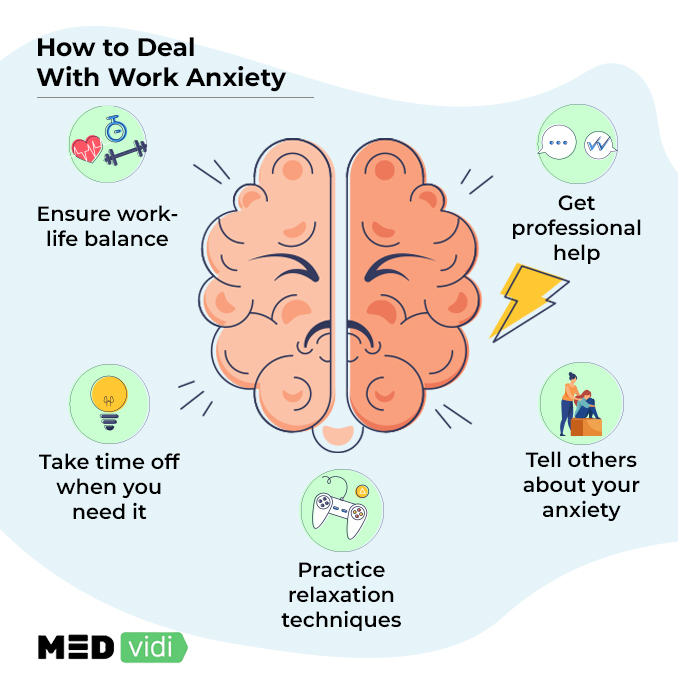
How to Deal With Work Anxiety
It is important that you manage your workplace anxiety so it doesn’t get worse or spill into other areas of your life. Here is what may be involved in overcoming work anxiety.
Managing Anxiety in the Moment
In the moment, these techniques can help calm your nervous system:
Box Breathing[12] : This lowers your heart rate by convincing your brain that you are not in trouble. Shallow breaths typically signal danger. Slow, controlled breaths, on the other hand, signal calm. Inhale for 4 seconds. Hold it for 4 seconds. And exhale for 4 seconds.Grounding[13] : This technique helps to keep you in the present moment. Name 5 things you can see, 4 things you can feel, 3 you hear, 2 you smell, and 1 thing you can taste.- Tension Release: Here, you clench your fists and whole body, hold for three seconds, and release. This exercise can help ease tension in your muscles.
- Step Away for a Few Minutes: Take a walk or get a snack to distract yourself for some time and find a solution when you calm down.
- Prioritize: Focusing on one manageable task at a time rather than scattering your energy everywhere can help coping with anxiety at work.
- Journal: Keep track of how you feel, what is happening (exact stressors, triggers), and how you are managing the situation (helpful changes you made or techniques you tried).
Preparing for Predictably Stressful Situations
Preparing for uncertainty by observing patterns can help you deal with your workplace anxiety on demanding workdays, during meetings and presentations, or during difficult conversations.
- Try to predict questions you may be asked in a meeting and write the answers down ahead of time.
- Organize your presentations and essential materials in advance, rehearse several times before the meeting.
- Time yourself when you rehearse or practice for a presentation.
- Accept uncertainty, as things don’t always go as planned.
You should, however, understand that helpful preparation is not the same as engaging in compulsive behavior like repeatedly checking emails, reassurance-seeking, or attempts to eliminate uncertainty.
Making Tasks and Deadlines More Manageable
Breaking your work into small bits, setting realistic deadlines, reducing multitasking, and using organizational tools can make seemingly difficult projects
- Divide a massive project into smaller bits that can be done in a couple of hours or even faster.
- Set realistic deadlines and use time buffers for unexpected situations.
- Focus on a single task at a time rather than doing several tasks at once.
- Close multiple browser tabs that are not in use.
- Use organizational tools like planners, reminders, and spreadsheets consistently.
Reducing Uncertainty Through Clear Communication
A clear idea of your priorities, responsibilities, deadlines, feedback, and demands can help you deal with work anxiety better. Proper communication may help you achieve that, for instance:
- Clarify the scope of work with your team lead.
- Confirm priorities when you have several tasks competing for your time. You can say: “I have projects A, B, and C on my desk. Which one do I work on first?”
- Confirm deadlines.
- Let your manager know if you need more support, more time, or both.
Proper communication is not the same as seeking reassurance excessively. Remember to respect boundaries and create your own quality checks.
Reducing Avoidance and Repetitive Anxiety Habits
Habits like procrastination, repeated checking, preparing too hard, seeking reassurance, and avoiding certain tasks may appear to reduce your work distress in the short term but they can hurt you in the long term. And may even worsen your work anxiety. Instead, you can gently develop healthier habits, for instance:
- Face situations you have been avoiding. For example, speak up during a meeting once a week.
- Commit to working on a difficult task for 5 minutes.
- Do the easy tasks, gain momentum then move on to the hard ones
- Don’t do the same confirmations more than three times unless it is necessary.
Wherever possible, remove yourself from toxic environments that involve bullying, harassment, sexual abuse, discrimination, trauma, or unsafe conditions.
Protecting Breaks, Boundaries, and Recovery Time
Some recovery time makes a difference. It could be a few minutes, hours, days, or even weeks. As long as it takes you out of the work for a while, it can help.
- Take lunch breaks away from your workstation.
- Create a ritual that helps you wind down at the end of workdays. It could be playing the piano, taking a walk, gardening, dancing, or anything that helps you leave work behind until the next day.
- If you work on computers, stay away from them when you don’t need to use them.
While personal coping strategies do help, they have limitations. If your anxiety affects how you go about your daily life, or your working conditions are truly stressful and unsupportive, personal coping strategies alone may not be sufficient. In these scenarios, you will have to seek formal workplace adjustment and organizational changes.
Talking to Your Employer
It is up to you to decide whether or not you should speak to your employer about your work anxiety. Before you do:
- Be honest with yourself about the work culture. If you are comfortable discussing this with your manager directly, an informal conversation will be suitable. If not, speaking to HR might be better.
- Focus on practical solutions, rather than just trying to explain your anxiety.
- Have your request documented somewhere, either in writing or as a recorded meeting.
Here are a few examples of practical workplace support you may request:
- A seat far from the air conditioner, if you have been feeling cold, or other adjustments
- A clearer role description
- Better pay based on your responsibilities
- Adjusted deadlines
- Other types of accomodation
Understanding Your Rights
Accommodation rights can differ from place to place. They may also depend on the size of your company, and the contract you have.
When the Workplace May Be the Main Problem
Sometimes, your workplace anxiety doesn’t come from within you, but rather happens as a response to a specific work environment. For example:
- Chronic overload
- Unreasonable expectations
- Poor management practices
- Mistreatment and hostility
- Safety concerns about your overall well-being
What to Do Next?
If your workplace itself is the reason you feel stressed and anxious, personal coping strategies will not fix corporate failures. There have to be changes in how things are run, or you may even have to consider changing your job.
- Document patterns in your personal journal: write out what makes you feel stressed, and the pattern this stress follows.
- Raise concerns about how you feel, presenting your documented data to HR: it is likely that HR will pay more attention when presented with documented evidence that the workspace is indeed unsupportive.
- Request change. You are allowed to suggest concrete solutions.
- Consider an internal transfer: look at moving to a different team, department, office branch, or working under a different manager if that is the problem.
- Seek appropriate professional or legal guidance: reach out to employment attorneys, labor unions, mental health advocates, and even your doctor.
- Plan to change jobs depending on your situation.
When to Seek Professional Help
You may have to seek professional help with your workplace anxiety if it weighs you down beyond what you can cope with, showing signs like:
- Problems completing small tasks or mental activities
- Symptoms of dread, panic, or physical pain that last a while
- Being unable to eat, or sleep, or relax at all
- You feel drawn to substance intake as a means to cope
What a Clinician May Assess
While evaluating your symptoms, a healthcare provider would want to know:
- The pattern of your symptoms: how severe they are, how often they show up
- The duration of your symptoms
- The possibility that you may have an anxiety disorder
- Any environmental or internal factors driving your anxiety
What May Be Included in Support or Treatment
Support or treatment for workplace anxiety
- Cognitive-behavioral therapy: this is a targeted talk therapy you have with a professional who helps you identify and challenge anxious thought patterns.
- Medical treatment with medication, if deemed clinically necessary.
- Writing you a doctor’s report which you show to your HR.
If your work anxiety gets to the point where you begin to feel completely hopeless or start to nurse thoughts of self-harm or suicide, please seek help immediately: contact crisis hotlines, such as 911, or 988 Suicide & Crisis Lifeline (toll-free), or your healthcare provider.
Conclusion
Workplace anxiety is a real problem people experience at work, despite not being a formal diagnosis. Unlike general anxiety, workplace anxiety shows up because of how you interact with your work. Its symptoms can mimic other anxiety disorders and can range from mild to severe, sometimes even requiring medical intervention. Speak to your HR about how you feel because of work, and find out what can be done to help you.
If you think you need professional support to deal with work anxiety, MEDvidi can help. Sign up to see a licensed healthcare provider to get your symptoms assessed and receive personalised recommendations for anxiety treatment online.
Frequently Asked Questions
Should I quit my job if it gives me anxiety?
Can work anxiety cause panic attacks?
If left unmanaged, work anxiety may have a profound impact on your nervous system and cause you to have panic attacks. However, only a healthcare professional can help you identify the triggers and causes of your panic attacks more accurately.
Can anxiety make you unable to work?
Is it normal to dread going to work every day?
No, it isn’t normal to have anxiety before work every day. If you dread going to work, you should look into why you feel that way.